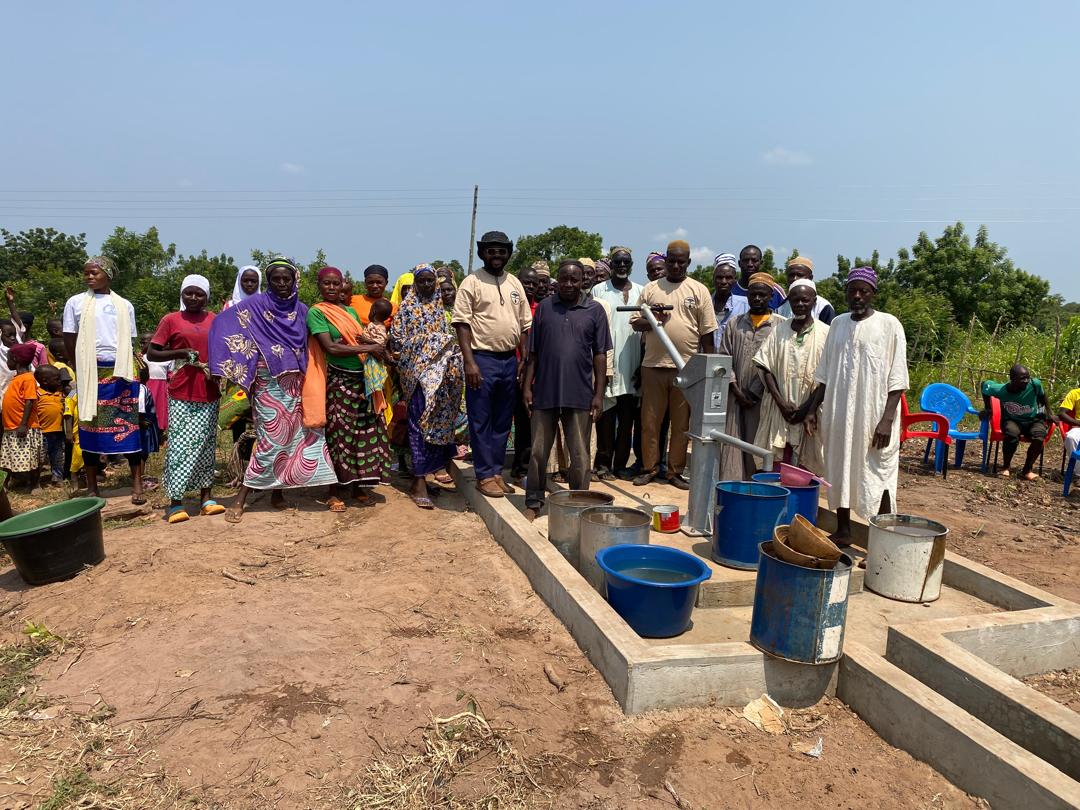
Where the money goes
Savannah Water Project is a 501(c)(3) registered nonprofit (Tax ID: 85-2030151). We publish our financials because donors deserve to know what their contributions paid for.
Annual Reports
Annual Impact Report 2025
You can also view our filings on ProPublica Nonprofit Explorer. Visit ProPublica
What a well costs
Overview
Most organizations publish one number for what a well costs. We don't, because it isn't true.
The cost of getting clean water to a village in northern Ghana depends on how deep we have to drill, how far the village is from a paved road, what kind of pump the depth requires, what happens when we hit a dry tap, and how much of the long-term maintenance we actually plan to pay for.
A typical SWP project, from first scouting trip through community handover, runs $3,500 to $6,000. Wells in harder-to-reach villages, wells deep enough to require mechanization, and projects that hit a dry tap on the first attempt cost more. The table below shows the ranges for each component. The sections after it explain what each line item actually pays for, and why we've chosen to spend on some things that many organizations cut.
Cost ranges, 2025
| Item | Cost (USD) | Notes |
|---|---|---|
| Borehole drilling | $1,800 – $3,000 | Varies with depth, distance, and road access |
| Second drill attempt (dry tap) | ~50% of first attempt | Occurs in roughly 8% of our projects |
| Closed-pipe casing | Premium over slotted | Higher-grade; longer well lifespan |
| Hand pump and installation | ~$1,200 | Preferred for wells under ~60m |
| Mechanization (pump + controls) | ~$1,200 | Required for wells beyond ~60m |
| Electricity for mechanized wells | ~$80 per year | Ongoing cost |
| Polytank holding tank | Varies by size | Primarily for mechanized wells |
| Community engagement and training | ~$800 | Pre-drill phase under our new process |
| Borehole blowing (sediment removal) | Up to $1,200 per service | May need to be repeated |
| Typical total per project | $3,500 – $6,000 | Excludes mechanization and multiple-well builds |
What each line pays for
Drilling the borehole. Getting a drill rig to a village and putting a hole in the ground deep enough to reach reliable water costs $1,800 to $3,000 in 2025. The variables that move the price are depth (northern Ghana's crystalline basement rock means water is pooled in fractures, and the depth required is unpredictable from village to village), distance and road access (a village an hour off the main road costs more than one near it; a village reachable only by seasonal track costs more still), and the geology itself, which sometimes forces a second attempt.
Second drill attempts. Roughly 8% of our wells hit a dry tap on the first attempt. When that happens, we drill a second hole. The second attempt costs about half of the first — the rig is already on site and the team is already mobilized, but the drilling itself still costs money. We budget for this in every project, whether it ends up being needed or not. An NGO that doesn't budget for it has to walk away when it happens.
Closed-pipe casing. Boreholes are lined with PVC casing to keep the walls from collapsing and to keep contamination out. The casing comes in two forms: slotted (perforated along its length) and closed (solid). We use closed casing everywhere except at the screened section at the water-bearing depth, where slotted is necessary by design. Closed casing is more expensive, but it pays for itself in longevity. Slotted casing along the full length is cheaper up front, and it's the option that turns into a contaminated, short-lifespan well a few years in. We don't use it.
Hand pumps over mechanization, when we can. Hand pumps and mechanized pumps cost about the same up front — roughly $1,200 either way. We prefer hand pumps wherever the depth allows it. They're more durable, far easier to repair locally, and have no recurring electricity cost. Mechanization is required for wells beyond about 60 meters, where a hand pump can no longer physically lift water efficiently. A mechanized well adds roughly $80 per year in electricity costs on top of the install. We've found this far more reliable than solar — which on paper looks like the obvious answer to a missing grid, but in practice fails harder and is much slower to repair when a single component goes down. We've moved off solar in the areas we serve.
Holding tanks. Mechanized wells typically include a polytank for water storage, sized to the village's needs. Polytanks come in different capacities, and the cost scales accordingly. Hand-pump wells generally don't need one — water is drawn directly as needed.
Community engagement. Under our new process, community engagement is the first phase of a project, not a step run alongside drilling. It costs roughly $800 per village. We spend significantly more time in a village before any drilling decision is made — meeting separately with chiefs, elders, women's groups, and the people who will actually be responsible for maintenance. This work has a cost. It's also the single best predictor of whether a well will still be working in five years.
Borehole blowing. Sediment accumulates in a borehole over time, and the flow rate drops accordingly. The standard maintenance procedure is to "blow" the well — using compressed air to clear the sediment and restore flow. This costs up to $1,200 per service, and sometimes needs to be repeated within the same year if a well has heavy sediment loading. A well that doesn't get this maintenance will flow progressively less and eventually fail entirely.
Site visits, parts, and wages. Our local maintenance team visits every well we've built on a documented schedule. That costs fuel, transport, and wages. It also costs replacement parts — pumps, seals, fittings — that wear out. The wells in this region that fail almost always fail not from a major breakdown but from a small part nobody had on hand. We try to keep the parts on hand. These costs are covered directly by our founding team, not by donor funds.
Redundancy: when one well isn't enough
For larger villages, or villages where a single failure would leave hundreds of people without water, the right answer is sometimes not one well but two or three. One pump goes down — and pumps do go down — and the village still has water. Putting all the eggs in one basket has cost wells in this region their value, and we've adjusted accordingly. A two-well village costs roughly double a one-well village, and for the communities where it's appropriate, we think the math is straightforward.
Why we publish this
Per-project cost breakdowns for completed wells are on each village's detail page. Donors can see exactly where the numbers landed for the well they helped fund. We publish the variability — including the 8% second-tap rate, the blowing costs, and the cases where mechanization adds significant expense — because the alternative is to give donors a single tidy number that hides the actual story. The actual story is what makes the difference between a well that lasts and a well that doesn't.
Overhead
Overview
When you donate to Savannah Water Project, your money builds wells. Not subscriptions, not airfare, not US-side administrative time. Wells.
We don't claim a "100% to projects" badge, which is a phrase we're skeptical of when other organizations use it. What we claim is a structure: two pools of money, separately funded, with a clear line between them. One pool pays for the organization. The other pays for the wells.
The Source
Everything that isn't direct project cost is covered by The Source — our founding group of donors. Software subscriptions, the website, US-side operations, airfare for our July field trips, salaries for our local maintenance team in Ghana, on-the-ground transport, and the administrative work of running a 501(c)(3) — all of it is paid for by The Source.
This separation is deliberate. It means a new donor's dollar isn't diluted across categories. It goes to drilling, casing, pumps, platforms, and community engagement in a specific village. We can tell you which one.
On scale
This model works because our founders are willing to sustain it, and because we've stayed small enough that overhead is genuinely manageable. As we grow, the cost of running SWP will grow with it. The Source is currently sufficient. We are honest with ourselves that this won't always be true, and we'd rather tell donors now than discover it later.
How donations work