Water crisis in northern Ghana
Water Crisis

Learn about the water crisis

The water crisis in northern Ghana is not one problem. It's several problems stacked on top of each other — geology, climate, history, governance, infrastructure, and tradition all working against the same outcome. Understanding why this is hard is the first step to understanding what we're trying to do.

The geography works against you

Ghana is split, more or less, into a wet south and a dry north. The five northern regions — Savannah, Northern, North East, Upper East, and Upper West — sit in the West African savannah belt, with a long dry season that runs roughly November through April. Surface water disappears in those months. Streams reduce to mud. Ponds turn green. Wells that draw from shallow sources go dry.

The water table itself is the next obstacle. Northern Ghana sits on crystalline basement rock — granite and similar formations — which means groundwater isn't sitting in a uniform aquifer the way it does in sedimentary basins. It's pooled in cracks and weathered zones, often deep, and the location and depth vary from one village to the next. Across Ghana, only an estimated 1.5% to 19% of rainfall actually replenishes underground reserves, and the picture is getting worse. Scientists project that northern Ghana will see roughly 10% less precipitation by 2050, with more erratic patterns swinging between drought and flooding.

Drilling here isn't like drilling in places with predictable groundwater. You don't know how deep you'll have to go and you don't know what you'll hit. When you do find water, you have to find out whether it's safe to drink.

Groundwater in the north often carries naturally high concentrations of manganese and fluoride, and recent studies in the Northern Region have found hazardous levels of arsenic, cadmium, and nitrates in groundwater samples — with children facing significantly higher health risks than adults.

Government support has been thin, and uneven where it exists

The north has historically received less infrastructure investment than the south. The pattern goes back to the colonial period and has been slow to reverse. The 2018 creation of the Savannah Region — splitting it off from the old Northern Region to bring administration closer to the people it served — was meant to help, but the underlying funding gap has not closed.

The scale of what's still needed is large. In 2025, the Managing Director of the Ghana Water Company estimated that resolving the urban water crisis in just three northern cities — Tamale, Yendi, and Damongo — would require about $302 million. That figure is for the cities. It doesn't include the thousands of farming villages outside of them, which is where we work.

National-level commitments exist. Ghana's 2024 Presidential WASH Compact committed $1.7 billion annually through 2030. But analysts have questioned whether those funds will actually reach vulnerable rural districts, and past rural water projects have suffered from poor targeting, weak monitoring, and inadequate maintenance budgets that leave new infrastructure dysfunctional within a few years. That last sentence — wells that stop working a few years after they're drilled — is the pattern we encounter most often when we visit a new village.

The grid stops before the village does

A significant share of the villages we work in have no connection to Ghana's electrical grid. That single fact rules out most of the standard solutions. An electric pump needs a power source. A water treatment system needs a power source. A monitoring sensor needs a power source. Without the grid, every option becomes a more expensive option: a generator that requires fuel and maintenance, a solar array that is fragile and hard to repair, a hand pump that limits the volume of water a community can actually use.

This is one of the reasons we've moved away from solar pumps in the areas we serve. Solar looks like the obvious answer to a missing grid. In practice, when a single component fails — a panel, an inverter, a controller — the whole system goes offline, and the replacement parts are expensive and slow to source from the south.

A fragmented landscape of traditional authority

Northern Ghana is governed in two overlapping systems: the formal apparatus of the Ghanaian state, and a much older system of traditional kingdoms and chieftaincies. Both matter. Neither, on its own, is sufficient to get a well built.

The major traditional polities of the north include the

  • Water drop icon
    Gonja Kingdom (founded in 1675, centered at Damongo in the Savannah Region, headed by the Yagbonwura)
  • Water drop icon
    Dagbon (centered at Yendi, headed by the Ya Naa)
  • Water drop icon
    Mamprugu
  • Water drop icon
    Nanun
  • Water drop icon
    Wala

Anthropologists describe these as the historically centralized states of the north. Alongside them are dozens of smaller communities with their own forms of governance — some with chiefs, some traditionally organized through councils of elders or earth priests.

The result is a landscape where authority over a village is split between a paramount chief, a sub-chief or skin holder, an earth priest who controls land use, the district assembly, and the regional government. To drill a well, you need to navigate all of them, and the protocols are different in every village.

This is why projects that arrive without local relationships tend to fail. A well built without the chief's blessing can be shut down a year later by his successor. A well built without the community's input can be abandoned because no one feels responsible for it. We've seen both outcomes more times than we'd like.
A long tradition of doing it the hard way

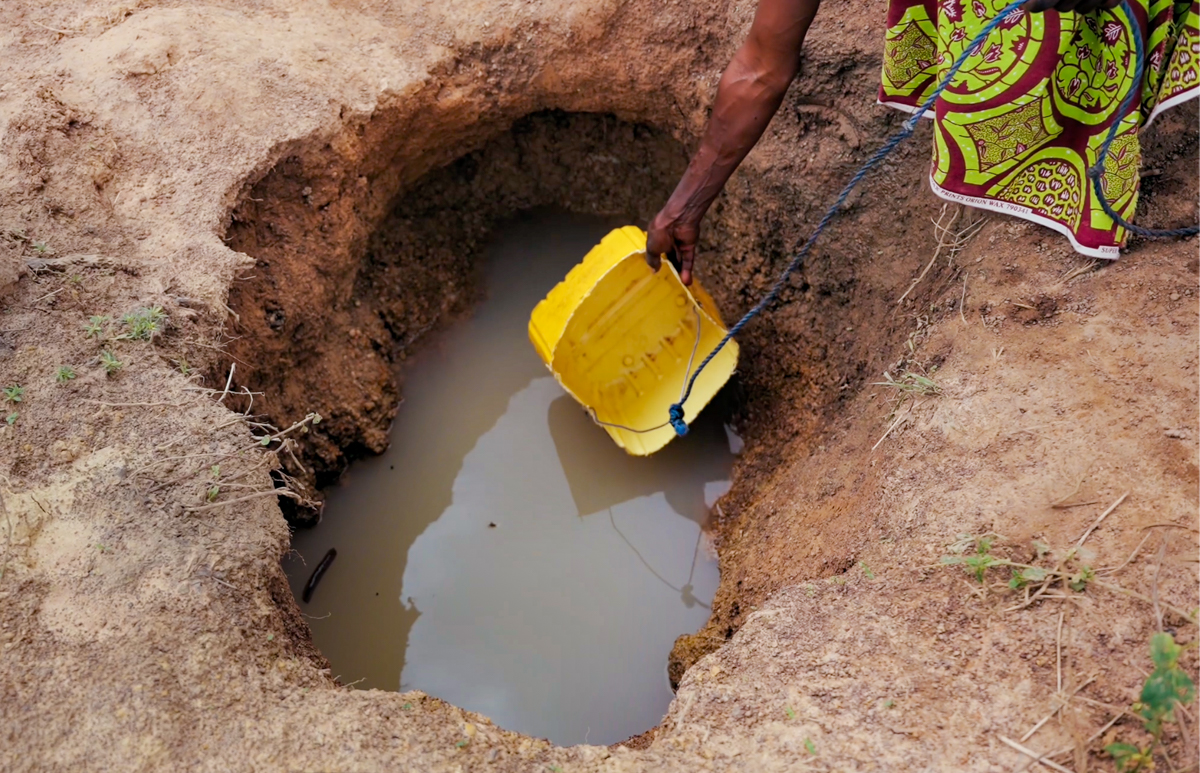
Long before borehole drilling reached northern Ghana, communities were getting their water from hand-dug wells — shafts dug by villagers, sometimes deep, lined with whatever materials were available. They still exist in many of the villages we visit. In the rainy season they fill. In the dry season they go down to mud. The water in them is rarely clean: livestock walk past, rainwater runoff carries contamination in, the shafts themselves are open to the air.

The cultural weight of hand-dug wells matters in ways that aren't always obvious. In some villages, families and clans have specific wells they have always used. There are spiritual associations with particular sources. There are disputes over who has the right to drink from where.

A new borehole is not just a piece of infrastructure — it is a change to a system that has worked, however badly, for generations.

Earning the buy-in to make that change stick takes time, and it takes conversations with people whose authority isn't visible on a government map.

What this adds up to

A village in the Savannah Region that needs clean water might be facing all of these problems at once: a dry season that wipes out surface sources, a deep and uncertain water table, naturally contaminated groundwater, no grid power, a chieftaincy structure that requires careful negotiation, a previous failed project that left the community skeptical of outside help, and a tradition of hand-dug wells that has shaped how people think about water for as long as anyone alive can remember.

This is the work. We don't claim to solve all of it. We claim to take it seriously — one village, one well, one ten-year commitment at a time.